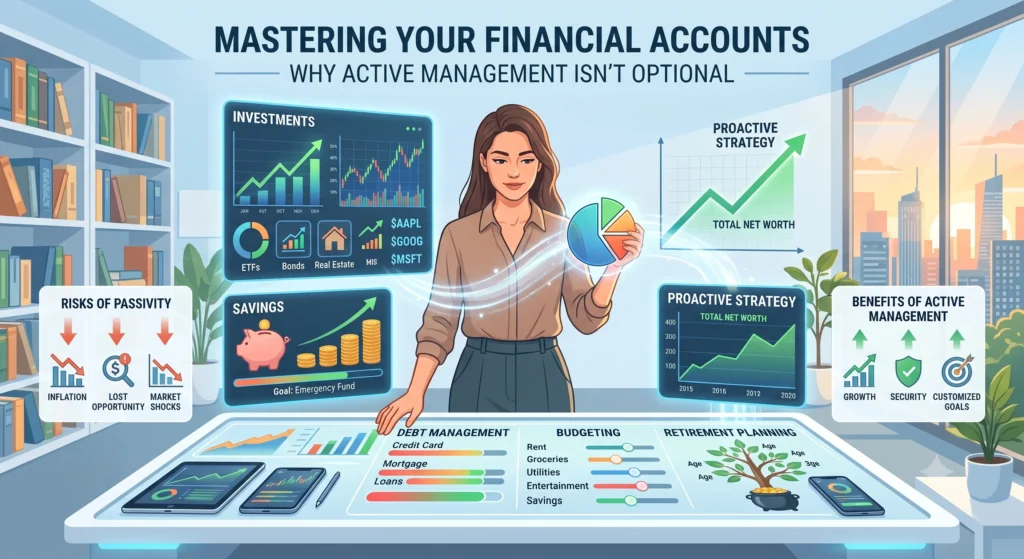

Most people think of their financial accounts as simple receptacles. A checking account holds cash. A savings account collects interest. An investment account, well, that’s where the market does its thing.
But that’s a dangerously passive way to look at it. Your accounts aren’t just boxes for money. They’re the literal infrastructure of your financial life. And how you manage them – or don’t – dictates pretty much everything.
I’ve seen firsthand the difference active engagement makes. It’s the difference between someone constantly stressed about money and someone building real, sustainable wealth. It’s about understanding what each of your accounts does, and more importantly, what it should be doing for you.
Beyond the Basics: Different Types of Accounts and Their Purpose
First, let’s get clear on what we’re even talking about. “Accounts” is a broad term. It covers a lot of ground in the finance world.
Transactional Accounts: Your Daily Financial Hub
- Checking Accounts: These are for your everyday cash flow. Paying bills, receiving your salary, swiping your debit card. They’re liquid, meaning you can access your money instantly. The goal here is efficiency and avoiding fees.
- Savings Accounts: Designed for short-to-medium term goals. Think emergency funds, a down payment on a car, or that vacation you’re planning. You want decent interest rates, but liquidity is still key.
You need these. Everyone does. But the trick is not letting too much money sit idle in them, especially checking, if it could be earning more elsewhere.
Growth Accounts: Building Your Future
- Investment Accounts (Brokerage): This is where you put money to work in the market. Stocks, bonds, mutual funds, ETFs. The risk is higher, but so is the potential for growth. These are typically for longer-term goals, or for money you don’t need immediate access to.
- Retirement Accounts (401(k)s, IRAs): These are specialized investment accounts with significant tax advantages. They’re explicitly for your post-working life. Maxing these out is probably one of the smartest financial moves you can make. The compounding growth over decades is incredible.
Ignoring these? You’re leaving serious money on the table. And time, which is even more valuable.
Credit Accounts: The Double-Edged Sword
- Credit Cards: A short-term loan you repay, usually interest-free, if you pay the full balance by the due date. Excellent for building credit history and earning rewards. Disastrous if you carry a balance and pay high interest.
- Loans (Mortgages, Auto, Personal): These are for specific, larger purchases. They have fixed repayment schedules and interest rates. Managing these well means understanding your terms and making payments consistently.
Your credit accounts directly impact your ability to borrow cheaply in the future. That matters a lot when you’re buying a house or starting a business.
Why Active Management of Your Accounts Isn’t Optional Anymore
It’s not enough to just have accounts. You have to manage them. Proactively. Consistently. Here’s why that’s non-negotiable in today’s world.
Protecting Your Financial Health
Fraud is rampant. Identity theft is a constant threat. Your accounts are prime targets. If you’re not regularly checking statements, setting up alerts, and using strong, unique passwords, you’re rolling the dice.
I get it. It’s tedious. But catching a fraudulent transaction early can save you weeks of headaches and potentially thousands of dollars. It’s a small investment of time for huge peace of mind.
Optimizing Your Money’s Potential
Are your savings sitting in an account earning 0.01%? You’re losing money to inflation. Seriously. Are you paying high fees on your checking account when there are free options available?
Every dollar you save in fees or earn in higher interest or returns is a dollar that works harder for you. This isn’t just theory. It’s real money, in your pocket, or not.
Achieving Your Goals Faster
Want to buy a house? Pay for your kid’s education? Retire early? Your accounts are the vehicles for those dreams. But they won’t drive themselves.
Setting up automated transfers to savings and investment accounts, regularly reviewing your budget, and adjusting contributions based on income changes – these are the actions that turn aspirations into reality. It requires intention.
Practical Strategies for Smarter Accounts Management
So, how do you actually do this? It’s simpler than you might think, but it requires discipline.
1. The Monthly Check-In: Your Financial Pulse
Pick one day a month. Maybe the 1st, maybe the 15th. Sit down and review all your accounts. Check balances, transactions, and ensure everything looks correct.
This isn’t just about catching fraud. It’s about seeing your overall financial picture. Are you spending too much? Are your investments growing as expected? This regular pulse check helps you stay on track.
2. Automate Everything You Can
Seriously, automate it. Set up automatic transfers from your checking to your savings, your investment accounts, and your retirement accounts the day after your paycheck hits.
Pay your bills automatically. This “set it and forget it” approach removes the temptation to spend money you’ve earmarked for savings or investments. It builds financial muscle without you even thinking about it.
I personally have money moving to three different accounts the day my salary lands. It’s out of sight, out of mind, and it works.
3. Understand Your Fees (and Avoid Them)
Banks and financial institutions make money on fees. Overdraft fees, monthly maintenance fees, ATM fees, foreign transaction fees. These can really eat into your money.
Read the fine print. Ask questions. Can you waive that monthly fee by maintaining a certain balance? Is there a no-fee alternative? A few minutes of research can save you hundreds over a year.
4. Align Accounts with Your Goals
Each account should have a purpose. Don’t just dump money into a generic savings account. Label it mentally, or even literally, in your banking app. “Emergency Fund.” “House Down Payment.” “Vacation 2025.”
This creates psychological buy-in. It makes saving less abstract and more concrete. You’re not just saving; you’re funding a specific goal.
5. Secure Your Accounts Like Your Life Depends On It (Because It Kinda Does)
Two-factor authentication is your best friend. Use it everywhere. Strong, unique passwords for every financial login. Change them periodically.
Don’t click on suspicious links or respond to unsolicited requests for personal information. Your bank will never ask for your password via email. Ever.
It sounds basic, but you’d be surprised how many people get complacent. A breach on one account can compromise your entire financial ecosystem.
Common Pitfalls to Avoid with Your Accounts
Even with good intentions, it’s easy to stumble. Here are a few traps I see people fall into regularly.
- Ignoring statements: “I trust my bank.” That’s great, but human error and fraud exist. Review them.
- Keeping too much cash: Money sitting in a low-interest checking account is losing value. Move excess to high-yield savings or investments.
- Not diversifying investments: Putting all your eggs in one basket, even a good one, is risky. Spread your money across different asset classes and accounts.
- Running on empty: Always having just enough to cover bills is a recipe for stress. Build a buffer, an emergency fund, that 3-6 months of living expenses.
- Forgetting about dormant accounts: Old 401(k)s from a previous job? A small savings account you opened years ago? Track them down. That’s your money.
Your Accounts: Tools for a Confident Financial Future
Ultimately, your financial accounts are powerful tools. They’re not just passive storage units for your money. They’re instruments for growth, security, and achieving the life you want.
Understanding them, actively managing them, and aligning them with your goals isn’t a chore. It’s an essential part of responsible adulthood. It’s how you build real financial confidence and control.
So, take a look at your accounts today. What are they doing for you? What could they be doing?
Discover more from Finance and Taxation
Subscribe to get the latest posts sent to your email.