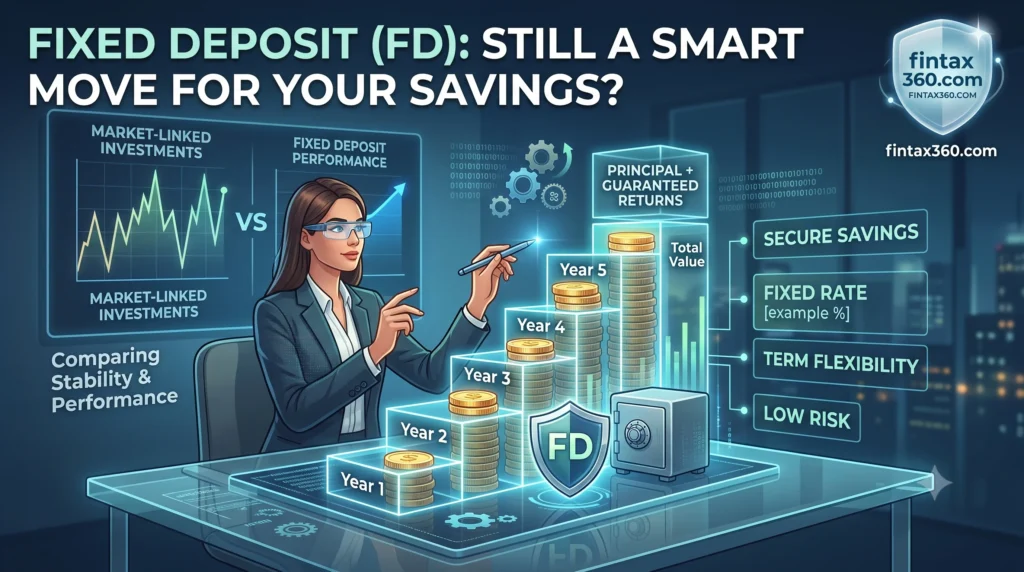

Fixed Deposit (FD): Still a Smart Move for Your Savings?
Thinking about a Fixed Deposit (FD)? Get the real scoop on how FDs work, their benefits, risks, and when they make sense for your money. Secure your savings.
You’ve probably heard of a Fixed Deposit, or FD. It’s a financial product that’s been around forever, a kind of evergreen option in the often-turbulent world of money. But in an era of flashy investments and digital trading, does the humble FD still hold its own?
I think it absolutely does. Not for everything, mind you, but for specific financial goals, it’s still tough to beat its core promise: stability and predictable returns. Let’s cut through the noise and figure out when an FD is genuinely the right choice for your cash.
What Exactly is a Fixed Deposit (FD), Anyway?
At its heart, a Fixed Deposit is a savings instrument where you deposit a lump sum of money with a bank or financial institution for a predetermined period. In return, you get a fixed rate of interest.
It’s pretty straightforward. You commit your money for, say, 1 year or 5 years, and the bank commits to paying you a specific interest rate for that entire duration. No surprises. That’s the big appeal.
The term “Fixed Deposit” itself tells you most of what you need to know. The interest rate is fixed. The tenure is fixed. And your capital is, generally speaking, very secure.
How Does an FD Actually Work?
Imagine you have Rs. 100,000 you want to save. You walk into your bank (or, more likely, log into your banking app) and decide to open an FD for 2 years at an interest rate of 6.5% per annum.
You hand over your Rs. 100,000. For the next 24 months, that money sits with the bank, earning interest. Depending on the type of FD you choose, that interest might be paid out regularly (monthly, quarterly) or compounded and paid at maturity.
When the 2 years are up, your FD matures. You get your original Rs. 100,000 back, plus all the accumulated interest. Simple, right?
This predictability is what makes the Fixed Deposit a foundational tool for many people’s financial planning.
The Undeniable Upsides: Why FDs Still Matter
I get it. FDs aren’t going to make you rich overnight. They aren’t designed for that. But they offer some critical advantages that often get overlooked in the pursuit of high returns.
1. Capital Protection and Security
This is the big one. Your principal amount is generally safe. Banks are regulated, and in many countries, deposits up to a certain limit are insured. For instance, in India, deposits are insured up to Rs. 5 lakhs by the DICGC.
This security is a huge relief, especially in volatile economic times. You know your money isn’t going to disappear due to market crashes.
2. Guaranteed Returns
Once you book an FD, your interest rate is locked in. If market rates drop later, yours stays the same. If they rise, well, you might feel a pang of regret, but your return is still guaranteed.
This certainty helps immensely with financial planning. You know exactly how much money you’ll have at the end of the term.
3. Simplicity and Ease of Use
Opening an FD takes minutes. Understanding how it works takes even less time. There are no complex charts to analyze, no daily market fluctuations to track. It’s set it and forget it, essentially.
This makes it incredibly accessible for everyone, regardless of their financial literacy.
4. Ideal for Specific Financial Goals
Got a down payment for a car in 18 months? Saving for your child’s school fees next year? An FD is perfect for these kinds of short to medium-term goals where you can’t afford to risk your principal.
You park the money, let it grow a little, and it’s there when you need it.
5. Senior Citizen Benefits
Many banks offer higher interest rates to senior citizens (usually 0.25% to 0.50% more). This can make a significant difference for retirees living off their savings, providing a better income stream.
It’s a thoughtful perk that acknowledges their need for stable, higher returns without taking on undue risk.
The Downsides: Where FDs Fall Short
No investment is perfect, and FDs have their drawbacks. It’s important to be realistic about these before committing your funds.
1. Inflation Risk
This is probably the biggest challenge. If the inflation rate is 6% and your FD is earning 5.5%, your money is actually losing purchasing power over time. You’re getting more rupees back, but those rupees buy less.
It’s a slow, silent erosion of wealth. You absolutely need to factor this in when considering long-term FDs.
2. Lower Returns Compared to Other Assets
Historically, FDs offer lower returns than equity mutual funds or direct stock investments over the long run. This is the trade-off for security.
If your goal is aggressive wealth creation, FDs aren’t your primary tool. They’re more about preservation and modest growth.
3. Liquidity Issues and Penalties
Your money is locked in. If you need it before maturity, you can usually withdraw it prematurely, but almost always with a penalty. This might mean forfeiting a portion of the interest or getting a lower rate.
So, don’t put money you might need urgently into a long-term FD.
4. Interest Rate Risk (When Rates Rise)
While a fixed rate protects you if rates fall, it works against you if rates rise significantly after you’ve locked in your FD. You’ll be stuck with a lower rate while new FDs offer more.
It’s a balance. Sometimes, laddering FDs (opening several FDs with different tenures) can mitigate this somewhat.
Types of Fixed Deposits You Should Know About
Not all FDs are created equal. Knowing the different types helps you pick the right one for your specific situation.
1. Cumulative vs. Non-Cumulative FD
- Cumulative: Interest is compounded and paid out along with the principal at maturity. This is great if you don’t need regular income and want your money to grow more aggressively.
- Non-Cumulative: Interest is paid out regularly (monthly, quarterly, half-yearly, annually). Ideal for those who rely on the interest for income, like retirees.
2. Tax-Saver FD
These FDs come with a 5-year lock-in period and allow you to claim a tax deduction (up to a certain limit) under specific sections of the income tax act. The interest earned is still taxable, though.
It’s a dual-purpose product: savings and tax benefit.
3. Senior Citizen FD
As mentioned, these offer higher interest rates for individuals above 60 years of age. A smart choice for retirees looking for better returns on their safe savings.
4. Regular FD
This is your standard FD, open to everyone, with various tenure options ranging from 7 days to 10 years or more.
When Should You Seriously Consider a Fixed Deposit?
An FD isn’t a silver bullet, but it’s a powerful tool in specific scenarios. Here’s when I think it really shines:
- Your Emergency Fund: You need this money to be safe and accessible (even with a penalty, it’s usually better than market-linked options). A short-term FD or a series of FDs can be perfect.
- Short-Term Financial Goals: Saving for a down payment, a child’s education fees due in a few years, or a planned large purchase. You can’t afford to lose this money.
- Capital Preservation: If you’re nearing retirement or already retired, preserving your capital and getting a steady income stream is paramount.
- Diversification: Even if you invest in stocks, having a portion of your portfolio in FDs provides stability and reduces overall risk. It’s a ballast.
- Low-Risk Appetite: If market volatility gives you sleepless nights, the peace of mind an FD offers is invaluable.
- Senior Citizens: The higher interest rates make FDs particularly attractive for consistent income.
Choosing the Right FD: What to Look For
So, you’ve decided an FD fits your needs. Now, how do you pick the best one?
- Interest Rates: This is obvious. Compare rates across different banks and financial institutions. Even a 0.25% difference can add up over time.
- Tenure Options: Match the FD tenure to your financial goal. Don’t lock up money for 5 years if you need it in 2.
- Bank Reputation and Stability: Stick with reputable banks. While deposit insurance offers protection, a stable bank means less hassle.
- Premature Withdrawal Penalties: Understand the charges if you need to break your FD early. Some banks are more lenient than others.
- Cumulative vs. Non-Cumulative: Decide if you need regular income or want maximum compounding.
- Special Benefits: Check for senior citizen benefits or tax-saving options if they apply to you.
My Take on the Fixed Deposit in Today’s World
The Fixed Deposit might seem old-fashioned to some, but its core value proposition hasn’t changed. It offers security, predictability, and simplicity – qualities that are often undervalued in our fast-paced financial landscape.
It’s not about choosing between an FD and stocks; it’s about understanding where each fits in your overall financial strategy. For guaranteed returns and capital protection, especially for specific goals or as part of a diversified, lower-risk portfolio, the FD remains a truly smart and essential tool.
Don’t dismiss it. Use it wisely, and it can be a bedrock of your financial security.
Discover more from Finance and Taxation
Subscribe to get the latest posts sent to your email.